Bhutan Festivals
Page updated – 15 April 2024
Festivals in Bhutan have reputations for being raucous, joyous affairs. The most popular for tourists are those held in Thimphu & Paro and those seeking a more intimate Bhutan experience should consider avoiding these major festivals as they mark the busiest time of the year for the tourism industry. Air seats and hotel rooms are frequently difficult to come by and all major sites see larger numbers of visitors on a given day.
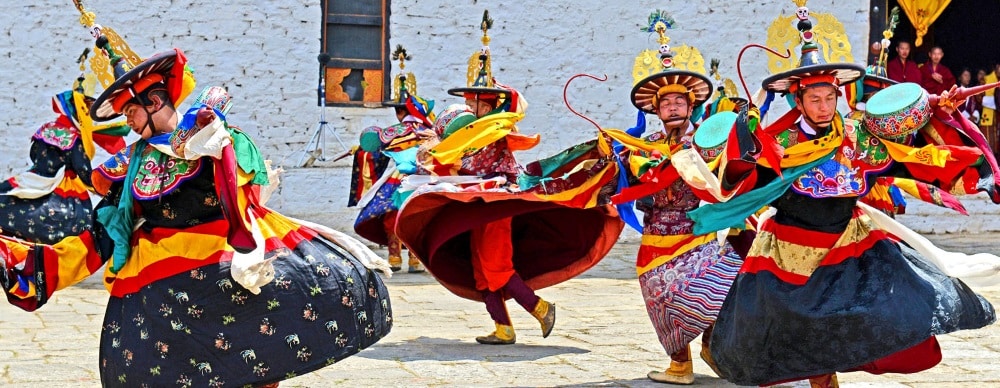
The Dzongs come to life with colour, music and dancing as valley dwellers and towns folk dress in their finest clothes and join together to exorcise evil spirits and rejoice in a new harvest. Rare masked and sword dances and other rituals are performed in the Dzong courtyard and temples. Tourists are allowed into the Dzongs to watch the spectacle, but not the inner sanctuaries.
Photography should always be discreet. It is generally allowed to take photographs at Tshechu’s but not at Dromchoe’s. Please scroll down this page for details of festivals and a guide to the daily schedule of performances.
OR CALL THE BHUTAN TRAVEL EXPERTS ON
AUS toll free, James – 0412 416 111, Nicola – 0413 598 669
Festivals Date Back To Middle Ages
Most of the dances date back from beyond the Middle Ages and are only performed once or twice each year. Each dance has its own spiritual importance and can be performed by monks or lay village elders dressed in bright costumes. Certain festivals end with the unveiling and worship of huge religious appliqués or Throngdrels. The moment of the unveiling is shrouded in secrecy and creates great excitement among all the participants.
Thimphu and Paro festivals are the most popular for tourists as they are the most accessible. There are other regional Dromchoes and Tshechu’s around the year, taking place in different localities of the kingdom, which are equally fascinating. Check the Festival date list. The Tshechu at Bumthang is well known for taking place almost entirely during the evening and containing exciting fire dances.
* Important Note – Except for the Paro & Thimphu Tshechu’s & the Jambay Lhakhang Drup all other festival dates are subject to change at very short notice.
PUNAKHA DROMCHOE (Punakha)
Punakha Dromchoe is a five day long festival dedicated to the goddess Mahakala. The religious aspects are performed in the same manner as in early times. On the last day, a play of warriors going off to war is enacted.
TAMSHINGPHALA CHOEPA (Bumthang)
The festival is celebrated for three days, on the open grounds in front of the Tamshing lhakang. This festival is in honour of the “Terton” (treasure discoverer) Pema Lingpa of the 15th century. The religious dances are generally the same, but performed in a slightly different manner, as of the Nyingmapa sect of Mahayana Buddhism.
JAMBAY LHAKANG DRUP (Bumthang)
This festival was introduced to celebrate the completion of the lhakang in the 7th century. The dances are performed by laymen from the villages in the valley. The high light of this festival is the ‘Mewang” – the fire ceremony.
TRONGSA TSHECHU (Trongsa)
The festival is celebrated within the courtyards of the Trongsa Dzong. It usually begins on the day after the Meeting of the Nine Evils, of the Bhutanese calendar. Falling in November or December of the international calendar. The festivities carry on for five days. The first day religious dances are “chamju” – dances without masks. On the following days, similar dances as of the Thimphu and Paro Tshechu’s are performed. A thongdrol is unfurled on the last day.

TSHECHU PROGRAM
The Tshechu/Festival is a religious festival in honour of Guru Rinpoche or a patron deity of the area. The Bhutanese dressed in their finest, come from all over for the festivities. It is believed that one who witnesses the tshechu is profusely blessed.
The festival is performed in the courtyards of the Dzongs or Lhakhangs (monasteries). All dances in the programme have religious significance. In between the religious dances, folk dances maybe are performed, depending on each region. Each day festivities begin at eight in the morning and continue till late afternoon, with lunch break in between. The order of the dances could differ from region to region.
DAY ONE
SHACHAM: Dance of the 4 Stags.
COSTUME: Knee-length skirts, masks of stags. The dance commemorates the subjugation of the God of the Wind by Guru Rinpoche who commandeers the gods stag as his own mount.
PELING GING SUM: Dance of the three kinds of Ging.
COSTUME: Knee-length skirts. The first part of the dance is performed with sticks and animal masks; the second with swords and fierce masks. The dance is performed to bring good luck and happiness to all beings, considered as blessings and are connected with religious ceremonies.
PACHAM: Dance of the Heroes.
COSTUME: Knee-length yellow skirts and golden crowns. No masks. They hold small bells (Drilbu) and drums (Damaru). The dance is performed to lead believers of the human world into the presence of Guru Rinpoche.
SHAWA SHACHI: Dance of the Stag and the Hounds.
The dance depicts the conversion to Buddhism of a hunter named Gonpo Dorji by the great saint Milarepa. More like a theatrical play than the other dances, it is very long and is usually performed in two parts, each of which concludes one day of the festival.
DRAMYEN HEM: Dance of the Lute
COSTUME: Elaborate with heavy woollen clothes (traditional felt boots, long black skirt, yellow shirt, brown coat) sword and a circular head dress. One dancer holds a traditional lute called Dramyen. The dance celebrates the founding of the Drukpa School.
DAY TWO
ZSHANA: Dance of the Black Hats.
COSTUME: Large black hat, felt boots, colourful long brocade dress. No masks. Dancers representing Tantrists with supernatural powers take possession of the dancing area and drive out evil spirits purifying the grounds with their footsteps. Beating as they dance, the Black Hat dancers proclaim victory over the evil spirits.
ZSHANA NGA CHAM: Black Hat Dancers with Drums.
Dancers destroy spiteful enemies, persecutors of beings, enemies of Buddhism beating their great drums. The sound of the drums represents religion and the invisible form of Buddhism.
KYECHAM: Attendant Dance.
COSTUME: Knee-length yellow skirts, animal masks, sword in the right hand. Historically related to a King named Norzang who had 500 queens. When the King leaves for battle, the protectors of the faith, guardians of the doctrine and the assembly of the Kings tutelary deities become his armed companions and allies during the battle, from which the King emerges victorious.
PHOLAY MOLEY: Dance of the Noblemen and the Ladies.
The dance is more of a play. There are two princes, two princesses, an old couple and the clowns Atsara. The moral of the story relates to the Buddhist doctrine of universal law which says that there is no real substance in worldly things.
DRAMITSI NGA CHAM: Dance of the Drummers from Dramtsi
COSTUME: Knee-length yellow skirts, different animal masks and drums. Twelve men wearing yellow skirts and masks beat drums as they dance; they represent Guru Rinpoche’s entourage and they are celebrating the victory of religion. The dance was composed by a saint who had a vision of Guru Rinpoche’s heaven. It was composed in the 16th century at Dramtsi monastery in Eastern Bhutan.
DAY THREE
DURDAG: Dance of the Lords of the Cremation Grounds.
COSTUME: White short skirts, white felt boots, white skull masks. Two skeletons guard the eight cremation grounds which are situated on the edges of the cosmic diagram where Tantric deities dwell. Their mission is to protect the cosmic design from demonic influences.
TUNGAM: Dance of the Terrifying Deities.
COSTUME: Beautiful brocade dresses, boots and terrifying masks. The dancers represent the entourage of one of the forms of Guru Rinpoche, Guru Dorji Dragpo who leads the dance. Armed with ritual daggers (Phurpa), the dancers execute and redeem an evil spirit by liberating its conscious principle from its body.
RAKSHA MANGCHAM: Dance of the Judgement of the Dead.
When all beings die, they wander in the intermediate state (Bardo) waiting to be led by their merits into their next destination until the ultimate goal of Nirvana. The dance contains more elements of drama than a dance and lasts approximately two hours. It is divided into two parts. It begins with a long dance by the assistants of the Lord of Death. Then a judgement scene is enacted.
DAY FOUR
CHHOSEY: Religious Song.
The dance is accompanied by a song commemorating the beginning of a pilgrimage to Mount Tsari in Tibet by the founder of the Drukpa School, Tsangpa Gyare.
BUMTHANG TER CHAM: Dance of Tamshing in Bumthang.
COSTUME: White serene looking masks, knee-length yellow skirts, a little bell and drum in hand. When Pema Lingpa, the Great Treasure Discoverer, was about to consecrate a temple at Tamshing, he dreamt of five tantrists who gave him orders to perform the Ter Cham Dance in order to fulfil the consecration of the temple. Pema Lingpa awoke to find that he remembered the dance precisely as he had dreamt it. When the dance was performed, all the gods rejoiced.
DURDAG: Dance of the Lords of the Cremation Grounds.
(See day three programme)
GING DANG TSHOLING: Dance of the Ging and Tsholing.
COSTUME: The Tsholing wear long colourful dresses and terrifying masks. The Ging wear replica of Tiger skins, and masks with a flag on top, and hold drums. On the occasion of the consecration of the Samye Monastery in Tibet, Guru Rinpoche initiated this dance to show the people of Tibet his palace, the Zangtopelri.
GURU TSHEN GYE: Dance by the Eight Manifestations of Guru Rinpoche.
The eight aspects under which Guru Rinpoche manifested himself on various occasions appear in a procession with the principal aspect of Guru Rinpoche shaded by a parasol. Certain other aspects are accompanied by their retinues and small celestial beings.
ORDER OF APPEARANCE
- Dorji Drolo- Liberated Diamond-Thunderbolt
- Tshokye Dorji- Diamond-Thunderbolt Born from a Lake
- Loden Chogse- He who Wishes to Acquire Supreme Knowledge
- Padmasambhava- Born of the Lotus Flower
- Guru Rinpoche- Most Precious Master
- Shakya Sengye- Lion of the Shakya Family
- Pema Gyelpo- Lotus-King
- Nyima Yoezer- Sun-Beam
- Sengye Drathok- He with the Voice of a Lion
Guru Rinpoche sits under a silk canopy wearing a golden mask surrounded by attendant fairies in white masks.
RIGMA CHUDRUG: Dance of the Sixteen Fairies.
When the demonstrations of the eight manifestations of Guru Rinpoche are completed, all are seated in their order beside Guru Rinpoche. Then the Sixteen fairies appear. They sing and perform two dances in front of Guru Rinpoche and his manifestations. They dance, first holding drums, then small hand bells and hand drums. The dresses are beautifully decorated with minute ivory carvings. After the dance, the fairies lead the whole entourage out.
